Updated 27 Nov 2026. About a 10-minute read. This guide is general information, not legal advice.*
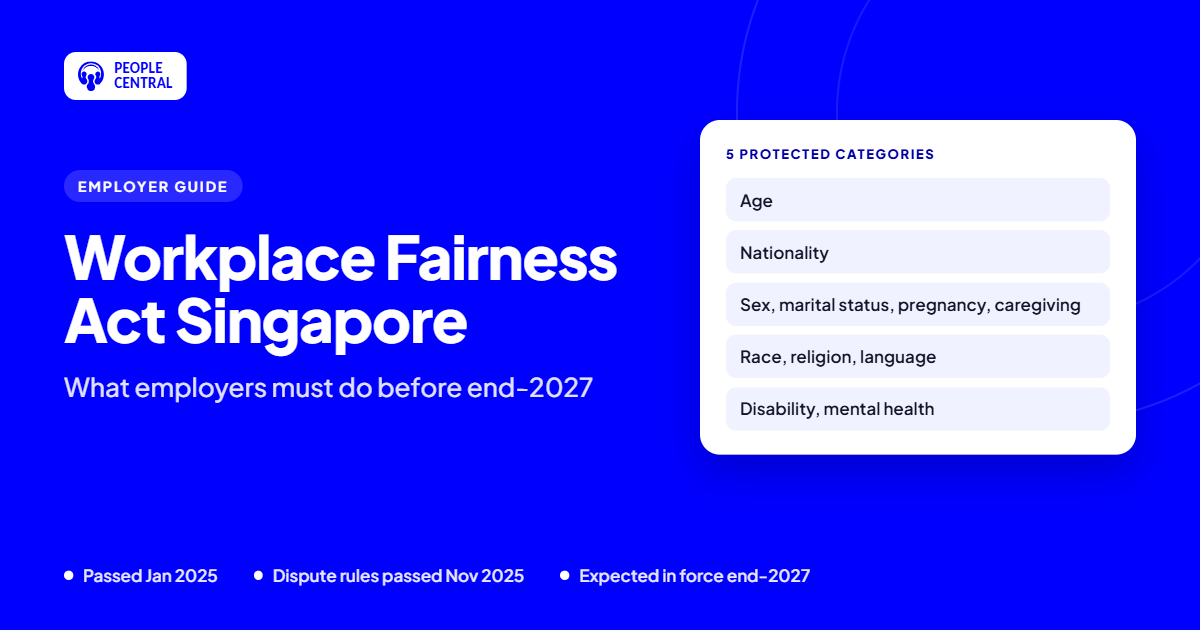
The short answer: Singapore’s Workplace Fairness Act (WFA) makes it unlawful for employers to make adverse employment decisions based on protected characteristics such as age, nationality, sex, pregnancy, caregiving responsibilities, race, religion, disability or mental health conditions. It requires employers to have a grievance handling process and protects employees who raise concerns from retaliation. The government aims for the Act to take effect at the end of 2027, and employers with fewer than 25 employees will be exempted at the start. Employers that are covered should use 2026 and 2027 to review hiring, appraisal, promotion and dismissal practices, set up a grievance process, and train managers.
Key dates
| Date | What happened |
|---|---|
| 8 Jan 2025 | Parliament passed the Workplace Fairness Bill, which sets out the protections and employers’ obligations. |
| 4 Nov 2025 | Parliament passed the Workplace Fairness (Dispute Resolution) Bill, which sets out how claims are resolved. |
| End-2027 | The government aims for the Act to take effect. |
Sources: MOM, passing of the Workplace Fairness Bill and MOM, Workplace Fairness (Dispute Resolution) Bill.
Who the Act applies to
The Act protects job applicants, employees and former employees. When the Act takes effect, employers with 25 or more employees are covered. During the debate on the second Bill, the Minister said small companies with fewer than 25 employees will be exempted at the start while they prepare, and that this will be reviewed five years after the law is implemented.
Smaller firms should not ignore it. The Tripartite Guidelines on Fair Employment Practices continue to apply to all employers, and a growing company can cross the 25-employee mark quickly.
The five categories of protected characteristics
According to MOM, the Act covers five categories:
- Age
- Nationality
- Sex, marital status, pregnancy status and caregiving responsibilities
- Race, religion and language
- Disability and mental health conditions
MOM has said these characteristics account for the vast majority of workplace discrimination complaints it receives. Discrimination on other grounds is still covered by the Tripartite Guidelines.
Which decisions are covered
The Act covers employment decisions at every stage. TAFEP’s employer guide gives these examples:
| Stage | Examples of decisions |
|---|---|
| Before employment | Not being hired for a job |
| During employment | Performance appraisals, promotion, selection for training |
| End of employment | Dismissal |
The Act also prohibits company policies and job advertisements that discriminate on the ground of a protected characteristic. A job ad that asks for “Chinese speakers only” or “below 35” without a genuine job reason is the kind of wording to remove now.
When you can consider a protected characteristic
The Act recognises that some jobs genuinely require a characteristic. TAFEP lists four “genuine requirements” where an employer may consider a protected characteristic:
- Reasonable performance of the job. For example, an interpreter role may require fluency in a language.
- Health and safety. For example, a security firm may assess whether an officer with a specific condition can safely carry and use weapons.
- Privacy. For example, a spa may hire female therapists for its female clientele.
- Legal and regulatory reasons. For example, a bus company may only hire driver trainees over 21 to meet licensing age rules.
If you rely on one of these, write down the reason when you make the decision. “We have always done it this way” is not a genuine requirement.
Grievance handling: what employers must have
Covered employers must put a grievance handling process in place. Based on the Bill and TAFEP’s guidance, the process should:
- Be communicated clearly to employees, so they know how to raise a concern.
- Lead to a proper inquiry into each grievance received.
- Review the grievance and inform the employee of the outcome.
- Protect the confidentiality of the person raising it, as far as possible.
The law deliberately avoids prescribing every detail, so a clear, written, consistently followed process matters more than a long policy document. When you reply to an employee, a clear written outcome helps; our free HR letter writer can draft one for you to review.
No retaliation
The Act gives stronger protection from retaliation to employees who report workplace discrimination or harassment. In practice, that means no adverse treatment of someone because they raised a grievance, supported a colleague’s complaint or took part in an investigation. Managers need to understand this, because retaliation is often unintentional: a cooler attitude, a lost opportunity, a sudden poor review.
What happens if there is a dispute
The Act is designed to resolve issues amicably, with legal action as a last resort:
- Internal grievance process. Employees are strongly encouraged to raise concerns through the employer’s process first.
- Mediation. If that does not resolve the matter, the employee and employer must attempt mediation, with the Tripartite Alliance for Dispute Management (TADM), before a claim can go further.
- Adjudication. If mediation fails, claims of up to and including S$250,000 are heard by the Employment Claims Tribunals, where legal representation is not allowed. Larger claims go to the High Court.
For enforcement, MOM can take calibrated action such as issuing directions, administrative financial penalties and, for serious cases, civil penalties. MOM and TAFEP have said they will take an education-first approach.
How to prepare: an eight-step plan
The Act sits alongside your existing obligations, so treat this as part of your wider HR compliance work.
- Confirm whether you are covered. Count your employees and plan for the 25-employee threshold if you are close to it.
- Audit job ads and application forms. Remove criteria tied to protected characteristics unless a genuine requirement applies, and stop asking for information you do not need, such as age or marital status, at the application stage. Our free AI job description writer helps you draft ads around skills and duties; check the final wording against this guide.
- Make hiring criteria explicit. Agree the skills and experience each role needs before you see candidates, and assess everyone against the same criteria. Structured, job-related questions help, and our free interview question generator can draft them.
- Document decisions. For hiring, appraisals, promotions, training selection and dismissals, record the merit-based reasons at the time. If a decision is challenged, notes written later carry far less weight. For appraisals, see performance appraisal and AI.
- Set up your grievance process. Write it down, name who handles grievances, set response times, and explain how confidentiality is protected.
- Train managers. Most discrimination risk sits with line managers making everyday decisions. Cover protected characteristics, genuine requirements, documentation and retaliation.
- Review your HR technology and AI tools. See the next section.
- Communicate with employees. Tell staff how to raise concerns and that they will not be penalised for doing so.
AI, HR software and the Workplace Fairness Act
The Act regulates employment decisions, not the tools used to make them. If a screening tool, a scoring model or a retention risk score shapes a decision about a candidate or employee, the employer still owns that decision. As more Singapore employers use AI in HR (a 2026 SNEF survey found 85% of AI-supported HR use cases still needed a person to sign off), it is worth checking your tools before the Act takes effect:
- Inputs: does any hiring, appraisal or retention tool use protected characteristics, or obvious stand-ins for them such as date of birth or graduation year, without a genuine requirement?
- Reasons: does every score or recommendation come with a reason a person can check and record?
- Human decision: does a person make and own every decision about an individual, rather than the system acting automatically?
- Video and voice screening: are candidates assessed on what they say, not on their face, accent or tone?
At People Central, our AI recruitment and HR analytics tools are designed around these rules. For example, retention risk views never use age, sex, nationality, pregnancy or health, and are meant as a prompt for a conversation, never a verdict.
For hiring tools specifically, read AI hiring and fair consideration. For a fuller look at where AI should and should not sit in HR, read our guide to AI for HR in Singapore, or run the free five-minute HR AI checklist, which includes a decision map and questions to ask your vendors.
Keeping the records the Act will ask for
Being able to show that decisions were based on merit depends on good records. A modern HRMS keeps appraisals, training history, job changes and employee records in one place, so the evidence behind a decision is there when you need it. See how PeopleCentral HRMS works, or book a walkthrough.
Related reading
- AI for HR in Singapore: a practical guide for employers
- AI hiring and fair consideration
- Understanding HR compliance
- Best practices for employee onboarding and offboarding
- Free five-minute HR AI checklist
Frequently asked questions
When does the Workplace Fairness Act take effect?
The government aims for the Act to take effect at the end of 2027. Both Bills were passed in 2025.
Does the Workplace Fairness Act apply to my company?
It applies to employers with 25 or more employees when it takes effect. Firms with fewer than 25 employees will be exempted at the start, with a review five years after implementation. All employers should still follow the Tripartite Guidelines on Fair Employment Practices.
What are the protected characteristics?
Five categories: age; nationality; sex, marital status, pregnancy status and caregiving responsibilities; race, religion and language; and disability and mental health conditions.
Do we need a written grievance policy?
Covered employers must have a grievance handling process. A written, clearly communicated process is the simplest way to show you have one and follow it.
Can a job ad still mention age, nationality or language?
Only where it is a genuine requirement of the job, such as language fluency for an interpreter. Otherwise, remove criteria tied to protected characteristics.
What happens if an employee makes a claim?
Concerns should go through your grievance process first, then mediation. If mediation fails, claims up to S$250,000 go to the Employment Claims Tribunals, and larger claims to the High Court.
Does the Act cover decisions made with AI tools?
The Act is about employment decisions, whoever or whatever helped make them. If an AI tool influenced a decision, the employer remains responsible for it.
This guide summarises public information from MOM, TAFEP and the Parliamentary debates as of November 2026. It is not legal advice. Details may change before the Act takes effect, so check MOM and TAFEP for the latest guidance, and speak to a lawyer about your situation.
Automate your CPF submissions with PeopleCentral
PeopleCentral HRMS applies regulatory updates automatically. Payroll is always compliant, without any manual reconfiguration.
Related articles
Best Attendance Automation System: What It Is and Why Accurate Attendance Matters
Best HR Management System (SMB): What It Is and Why Small Businesses Need One